GPON ONU, ONT and OLT: complete understanding of PON architecture
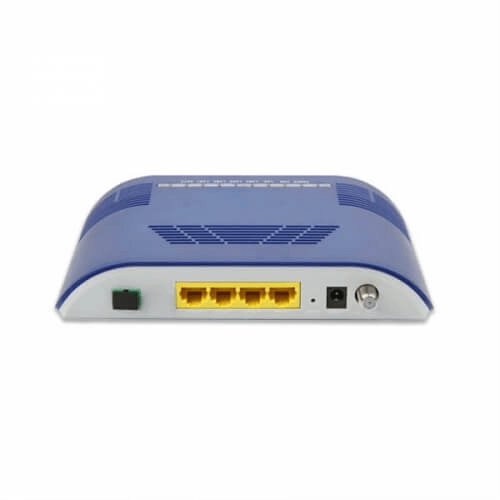
Table of contents
FTTH fiber networks almost all rely on the same basic infrastructure: a passive optical network, or PON. Behind this technology lie two key pieces of equipment — the OLT on the operator side and the ONU/ONT on the subscriber side — whose mastery is essential for any fiber technician, network manager or integrator working on FTTH deployments. This guide explains the role of each, the GPON, EPON and XGS-PON variants, and how to choose the right equipment for your infrastructure.
PON architecture: why GPON?
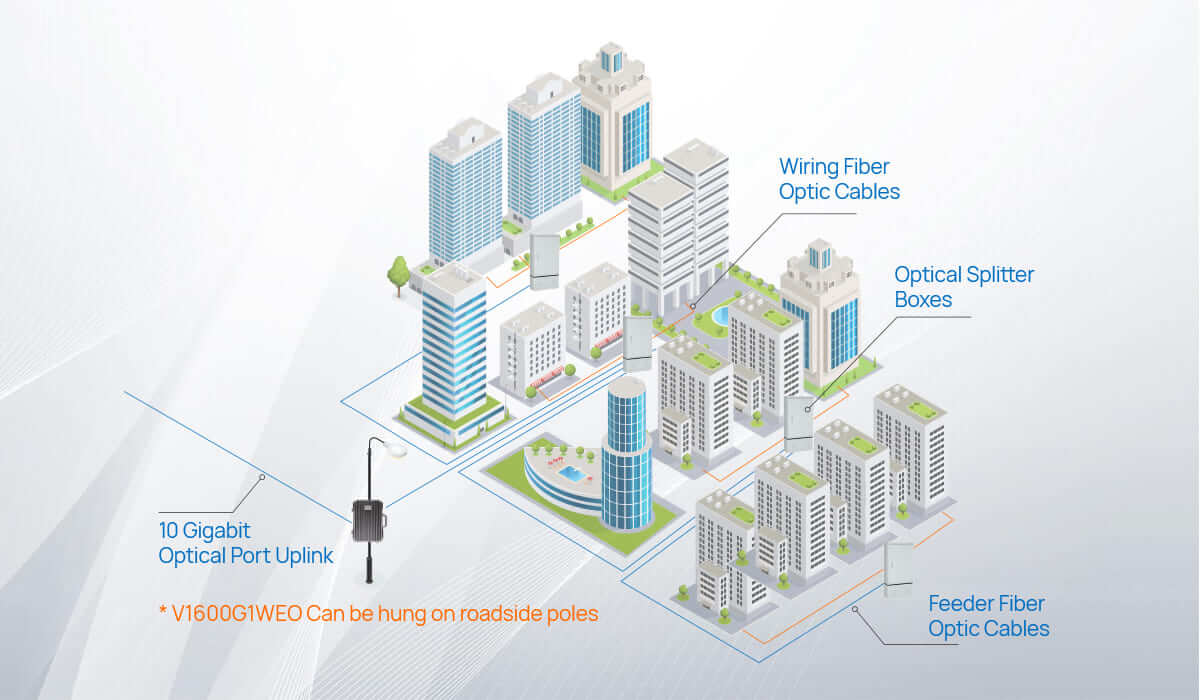
A PON (Passive Optical Network) is a fiber optic distribution infrastructure that uses no active equipment between the operator's central office and the subscriber's premises. Transmission relies solely on passive optical splitters — components without electrical power that divide the signal.
The main advantage is economic: a single fiber from the OLT can serve up to 128 subscribers (1:128 ratio in GPON) by splitting the signal at the splitters. This considerably reduces installation costs compared to a point-to-point architecture where each subscriber would require their own dedicated fiber to the central office.
A GPON FTTH deployment costs on average 30 to 40% less than an equivalent point-to-point architecture, thanks to the pooling of transport fiber.
GPON (Gigabit Passive Optical Network) is the standard defined by ITU-T G.984 and is now the dominant technology in FTTH deployments in Europe and France. It offers 2.5 Gbps downstream (operator → subscriber) and 1.25 Gbps upstream, shared between subscribers on the same PON port.
GPON ONU and ONT: the subscriber-side terminal
The ONU (Optical Network Unit) or ONT (Optical Network Terminal) is the equipment installed at the subscriber's premises. It handles conversion between the fiber's optical signal and usable electrical interfaces (Ethernet, analog telephony, WiFi). In practice, ONU and ONT often refer to the same device — the technical nuance being that the ONT is directly connected to the terminal equipment (box), while the ONU supplies a sub-network via an Ethernet switch.
The most common ONU/ONT configurations:
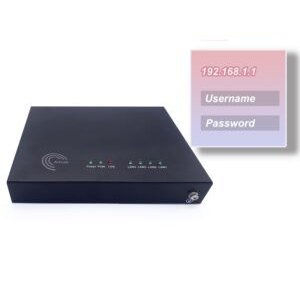
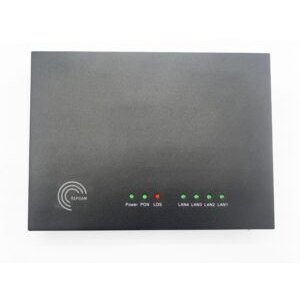
- 1GE ONU — single Gigabit Ethernet port, minimalist configuration for simple residential installations
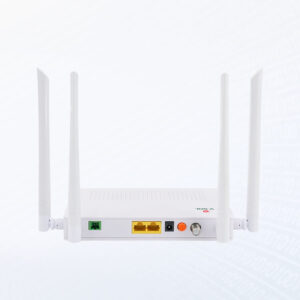
- 1GE + 3FE ONU — 1 Gigabit port + 3 Fast Ethernet ports, ideal for small buildings or business premises
- 1GE + 3FE + PoE ONU — with integrated PoE power to directly power WiFi APs or IP cameras
- Integrated WiFi ONU — with 2.4/5 GHz WiFi module, for all-in-one residential deployments
- CATV ONU — with RF port for coaxial cable television, common in mixed installations
The optical connector of an ONU is always an SC/APC (green connector, 8° angle). This connector plugs into the fiber patch cord coming from the PTO (optical termination outlet) in FTTH homes.
ONU / ONT difference in practice
For a field technician, the distinction is simple: if the device connects directly to the box (1 outgoing ethernet port), it's an ONT. If it powers several devices via an internal local network (multiple ports or integrated switch), it's an ONU. In both cases, the fiber-side connection is identical: SC/APC on the PTO.
-
Promo !
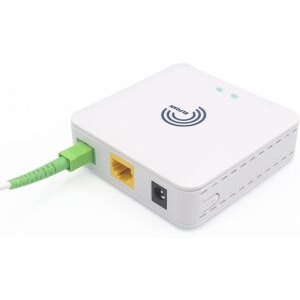
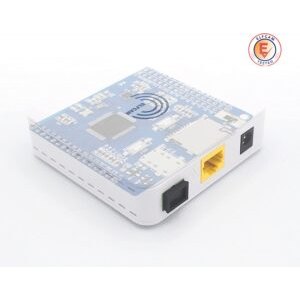
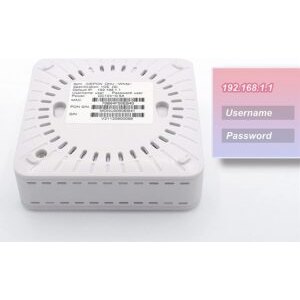
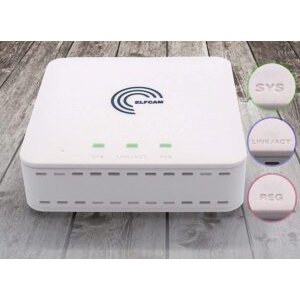
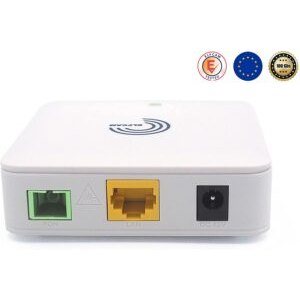
Elfcam – 1GE ONU para GPON/EPON OLT, con Puerto de Fibra Óptica Monomodo SC/APC (Ref:6404)
4 comments Precio original: 49,99 €.41,66 €Precio actual: 41,66 €. + -
Promo !
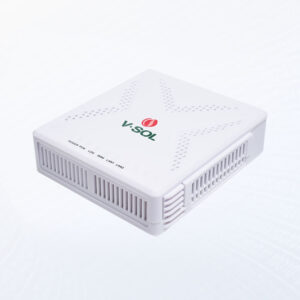
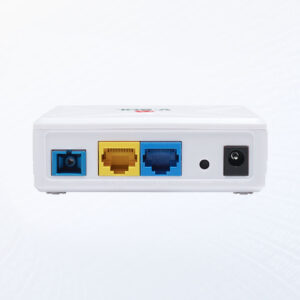
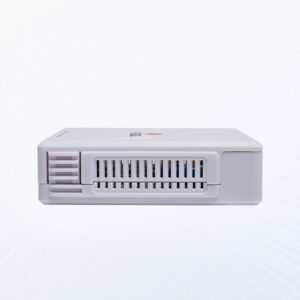
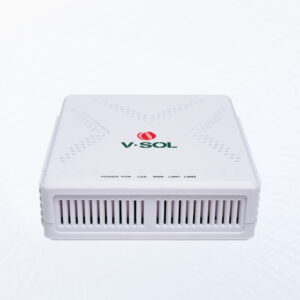
V.SOL – ONU para GPON/EPON OLT, con Puerto de Fibra Óptica Monomodo SC/UPC (1GE + 2.5GbE) (Ref:6965)
2 comments Precio original: 58,33 €.52,49 €Precio actual: 52,49 €. + -
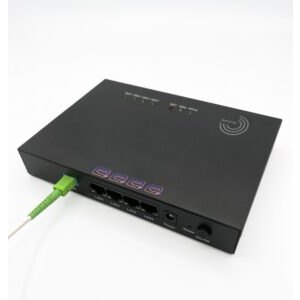
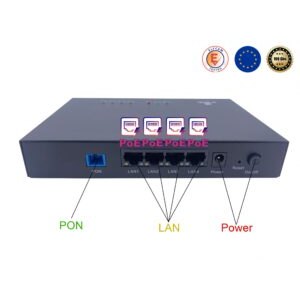
V-SOL 1GE+3FE POE XPON ONU (Ref:7025)
3 comments 83,33 € + -
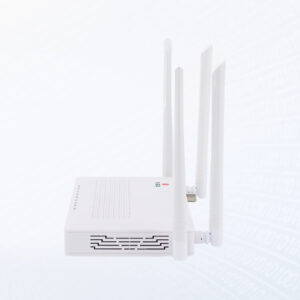
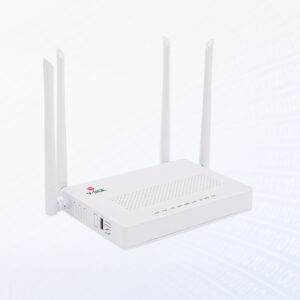
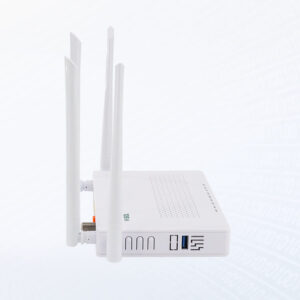
V-SOL 2GE+CATV+USB3.0+WiFi ONU (Ref:7019)
3 comments 74,99 € +
GPON OLT: the operator-side concentrator
The OLT (Optical Line Terminal) is the central equipment of the PON network, installed at the network head — typically in the operator's NRO (optical connection node) or DSLAM, or in the server room of a private network (campus, hotel, managed residence). The OLT is the only active equipment in the entire architecture: it manages the temporal synchronization (TDMA) of transmissions to and from each ONU.
The main functions of an OLT:
- PON aggregation — each PON port manages up to 64 or 128 ONU/ONTs simultaneously
- Bandwidth management — dynamic allocation (DBA) according to each subscriber's needs
- ONU authentication — terminal registration by serial number or LOID
- VLAN and QoS — separation of Internet, voice and IPTV traffic
- Network uplink — GbE or 10GbE uplink ports to the core network (router, BRAS)
An Elfcam OLT with 4 PON ports can thus manage up to 256 simultaneous subscribers (4 × 64) on a single rack unit. The 16-port version extends this capacity to 1,024 subscribers — sufficient for an FTTH deployment of an entire neighborhood or a large campus.
-
Promo !
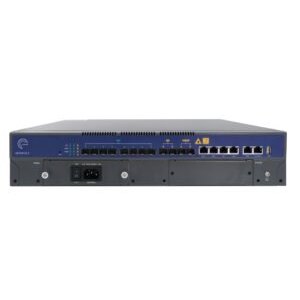
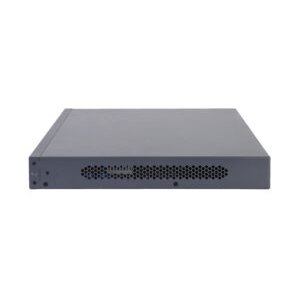
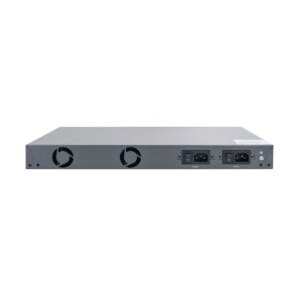

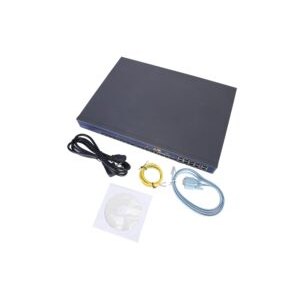
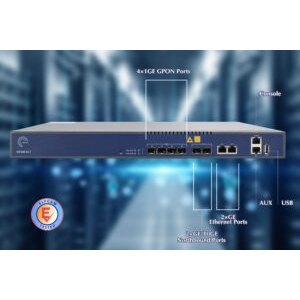
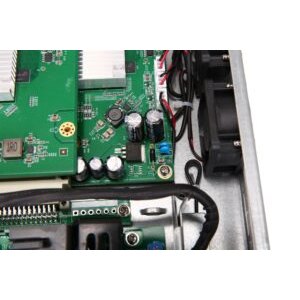
GPON OLT con 4/8/16 Puertos PON, Actualización Automática, Gestión Web EMS (8 Puertos PON) (Ref:6686)
2 comments Precio original: 666,66 €.583,33 €Precio actual: 583,33 €. + -
Promo !
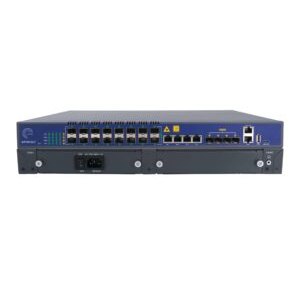
GPON OLT con 4/8/16 Puertos PON, Actualización Automática, Gestión Web EMS (16 Puertos PON) (Ref:6692)
3 comments Precio original: 1 499,99 €.1 416,66 €Precio actual: 1 416,66 €. + -
Promo !
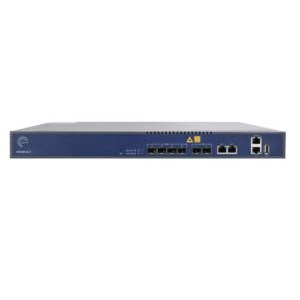
GPON OLT con 4/8/16 Puertos PON, Actualización Automática, Gestión Web EMS (4 Puertos PON) (Ref:6652)
2 comments Precio original: 1 249,99 €.1 083,33 €Precio actual: 1 083,33 €. +
GPON vs EPON: what are the differences?
The two main PON standards deployed globally are GPON (ITU-T G.984) and EPON (IEEE 802.3ah). Although they fulfill the same role, they differ on several technical points and are incompatible with each other — a GPON ONU cannot operate on an EPON OLT, and vice versa.
| Criterion | GPON | EPON |
|---|---|---|
| Standard | ITU-T G.984 | IEEE 802.3ah |
| Downstream rate | 2.5 Gbps | 1.25 Gbps |
| Upstream rate | 1.25 Gbps | 1.25 Gbps |
| Max. split ratio | 1:128 | 1:32 (typical) / 1:64 |
| Wavelengths | DL 1490 nm / UL 1310 nm | DL 1490 nm / UL 1310 nm |
| Transport protocol | GEM (GPON Encapsulation Method) | Native Ethernet 802.3 |
| Dominant deployment | Europe, Asia, Americas | Asia (China, Japan) |
| Compatibility | Not compatible with EPON | Not compatible with GPON |
In France, GPON is the standard imposed by Orange for its public FTTH network. SFR, Bouygues and Free also use GPON on their infrastructures. EPON remains present on some enterprise equipment and in industrial installations, particularly in Asia.
How to identify the technology of an OLT or ONU?
Check the technical sheet: a GPON device mentions ITU-T G.984, an EPON one mentions IEEE 802.3ah. Some devices are XPON (GPON + EPON) and automatically adapt to the detected OLT — this is the case with V-SOL ONUs such as Ref 7025.
XGS-PON and XGPON: the 10G speed boost
The next generation of GPON is XGS-PON (10-Gigabit Symmetric PON, ITU-T G.9807.1), which multiplies fiber rates by 4: 10 Gbps downstream and 10 Gbps upstream. This is the technology to which European operators are gradually migrating to meet the bandwidth demand of cloud, gaming and 4K videoconferencing uses.
The particularity of XGS-PON is its coexistence with GPON on the same fiber infrastructure. The two technologies use different wavelengths, allowing an XGS-PON OLT to serve simultaneously GPON ONUs (older subscribers) and XGS-PON ONUs (new subscribers) on the same distribution network. Migration is therefore progressive, without replacing cables or splitters.
Note: XGPON (G.987, 10G downstream / 2.5G upstream) is an asymmetric variant less deployed than XGS-PON. Free notably uses XGS-PON on its Freebox Ultra, which has a 10G SFP+ port on the subscriber side.
SFP+ XGS-PON module for Fritz!Box and 10G ONU
To connect a Fritz!Box 5530 or 5590 Fiber directly to an XGS-PON network, the Elfcam SFP+ XGS-PON module (Ref 28554) replaces the dedicated ONU. It slides into the SFP+ port of the box and provides the 10G link to the operator's OLT.
SFP GPON modules: the compact alternative to dedicated equipment
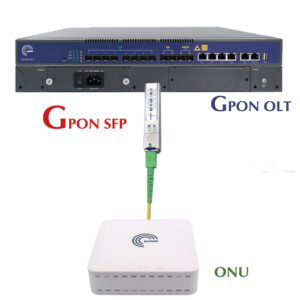
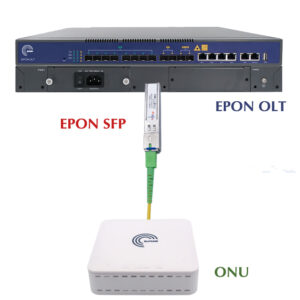
An alternative to dedicated ONU/ONTs is the SFP GPON module — a standard SFP form factor transceiver that integrates the GPON logic in a 1.25G or 2.5G form factor. This type of module slides into the SFP port of a managed switch or compatible router, transforming this equipment into a GPON ONU without an additional dedicated enclosure.
SFP GPON modules come in two power classes:
- PX20+ / PX20++ — optical budget of 29–32 dB, coverage up to 20 km, for standard residential FTTH deployments
- Class C++ — optical budget of 32–35 dB, for long distances or splitters with high ratio (1:128)
SFP OLT modules (operator side) and SFP ONU (subscriber side) are distinct and not interchangeable. An SFP GPON OLT TX module at 1490 nm is designed to be inserted into the OLT, while an SFP ONU TX at 1310 nm is installed in the subscriber equipment.
-
Promo !
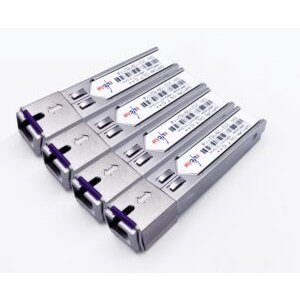
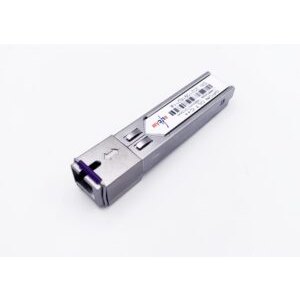
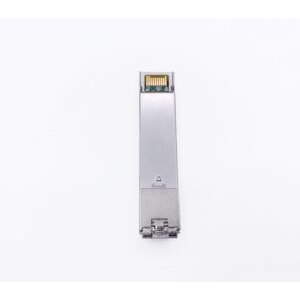
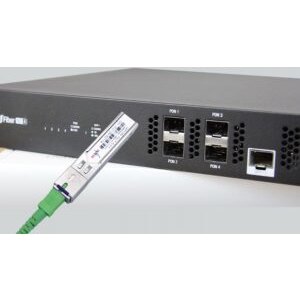
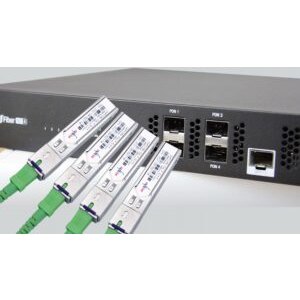
Transceptor GPON OLT 2.5Gbps SFP Clase C++ TX1490nm / RX1310nm 20km, Transceptor Óptico SC/UPC 20KM (Ref: 6631)
4 comments Lot 1 – Lot 4 Precio original: 79,99 €.71,99 €Precio actual: 71,99 €. + Ce produit a plusieurs variations. Les options peuvent être choisies sur la page du produit -
Promo !
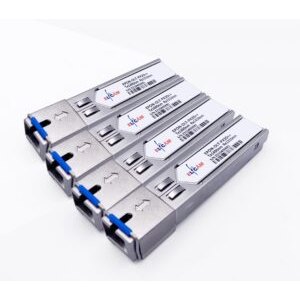
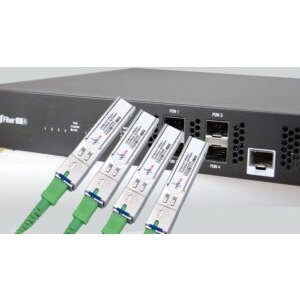
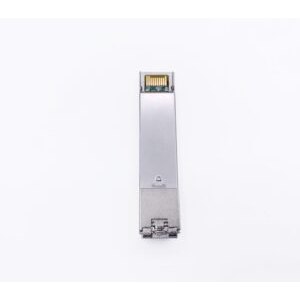
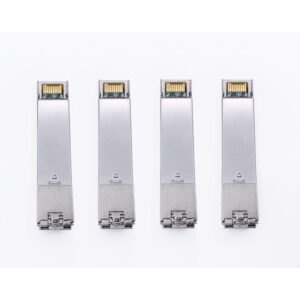
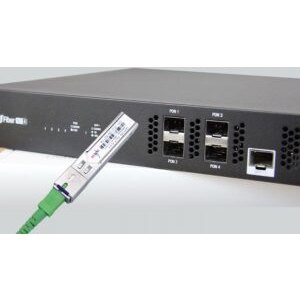
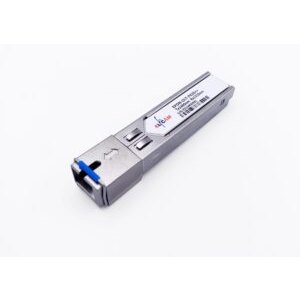
Transceptor OLT SFP 1.25G GPON EPON PX20++, TX1490nm / RX1310nm 20km, Transceptor Óptico SC/UPC (Ref:6681)
3 comments Lot 1 – Lot 4 Precio original: 79,99 €.71,99 €Precio actual: 71,99 €. + Ce produit a plusieurs variations. Les options peuvent être choisies sur la page du produit -
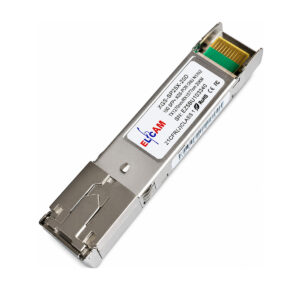
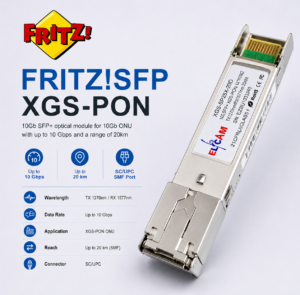
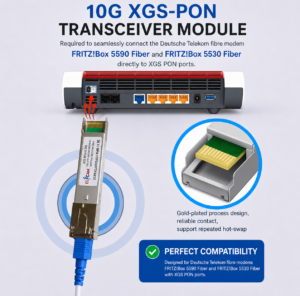
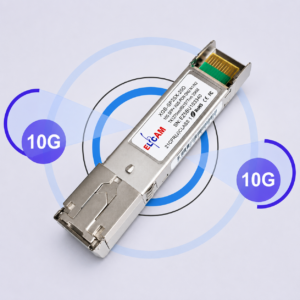
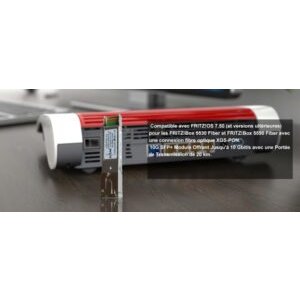
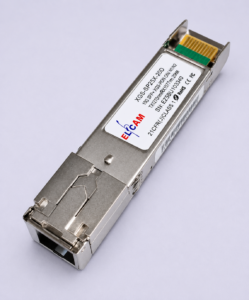
Módulo XGS-PON óptico 10G SFP+ para 10GbE ONU, hasta 10 Gbit/s, compatible con Fritz!Box 5530 Fiber y Fritz!Box 5590 Fiber
3 comments 41,66 € +
Sizing a PON network: split ratio and optical budget
The sizing of a PON network is based on two fundamental parameters: the split ratio and the optical budget.
The split ratio is the ratio between the number of PON ports of the OLT and the number of subscribers served. A 1:64 ratio means that one PON port serves 64 ONUs. The higher the ratio, the lower the bandwidth budget per subscriber and the greater the optical losses to compensate.
The optical budget is the maximum acceptable loss on the optical path between the OLT and the ONU. It is calculated as follows:
Optical budget = Cable losses (0.35 dB/km × distance) + Splitter losses (3.5 dB per split level) + Connector losses (0.3 dB × number) + Margin (3 dB)
For a standard GPON deployment:
- OLT → subscriber distance: 20 km max.
- 1:64 splitter: attenuation ≈ 18 dB
- Typical total budget: 28 dB (class B+) or 32 dB (class C++)
If your deployment exceeds this budget (long distances, multiple cascading splitters), you will need to use SFP Class C++ modules or insert an EDFA amplifier. Elfcam reinforced outdoor fiber cables G.657.A1/A2 with PE sheathing are recommended for long-distance links exposed to UV and temperature variations.
Optical budget verification with a PON multimeter
A 10G PON optical multimeter like the E-286 Elfcam (Ref 22032) allows you to measure power levels on GPON (1310/1490/1550 nm) and XGS-PON (1270/1577 nm) wavelengths in a single measurement, without interrupting service. Essential for commissioning and field troubleshooting.