Fiber optic converters (media converters) : role, characteristics and choice
Contents
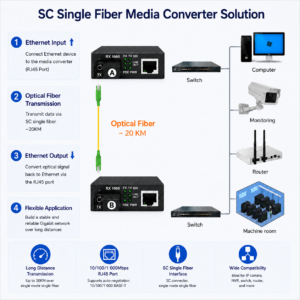
A fiber optic converter — also called a media converter — is a small box that transforms a copper (RJ45) Ethernet signal into an optical (fiber) signal and vice versa. It makes it possible to exceed the 100-meter limit of standard Ethernet cable to reach several kilometers via optical fiber.
This guide explains the role of media converters in a network, their technical characteristics, and how to choose the right model between integrated SFP, modular SFP, PoE management, and transmission distances.
What is a fiber optic converter ?
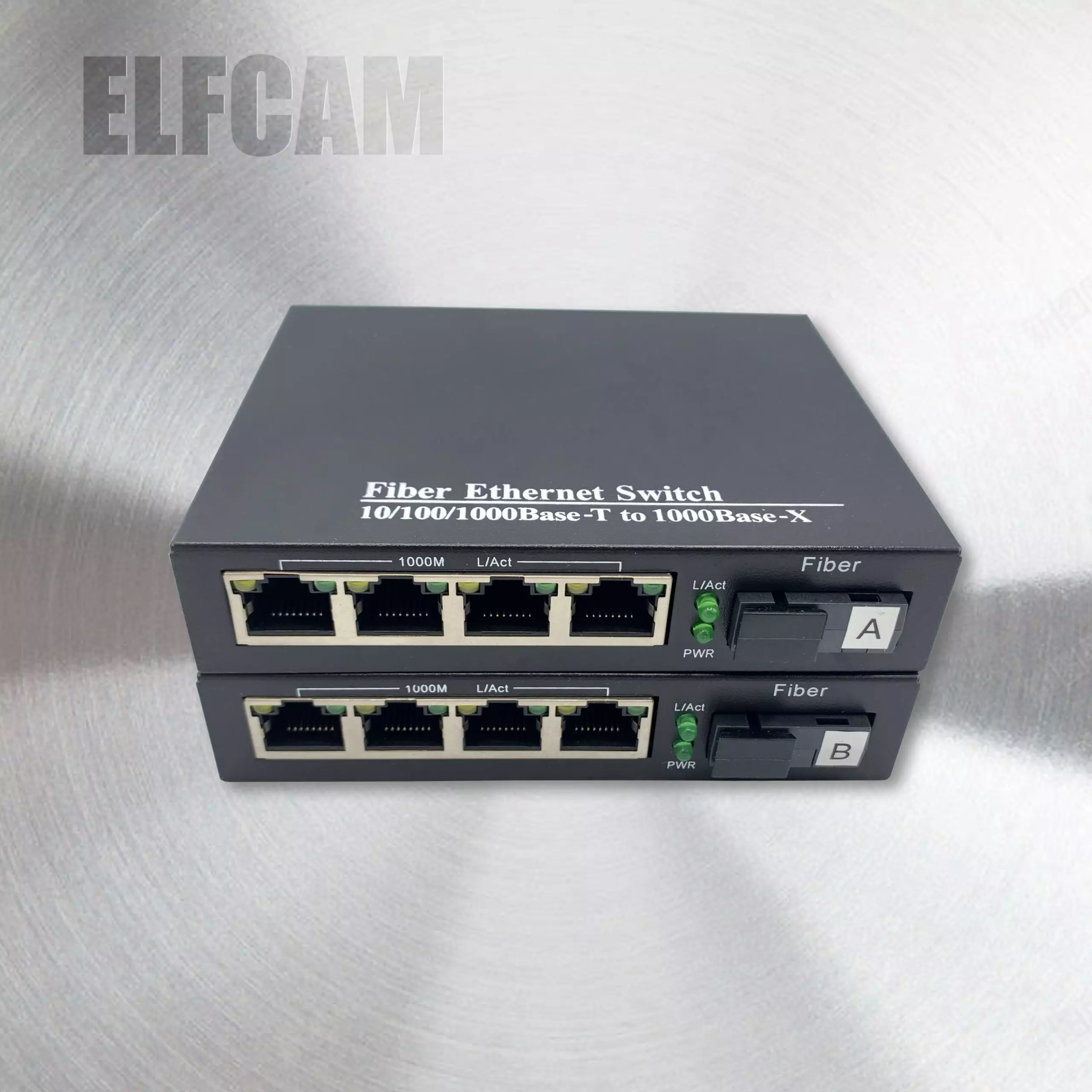
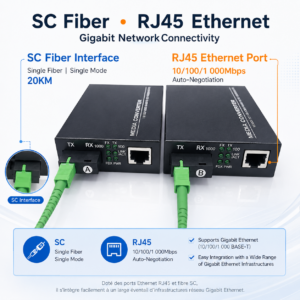
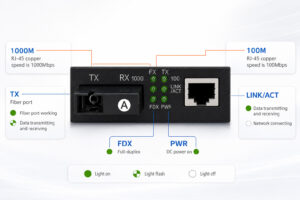
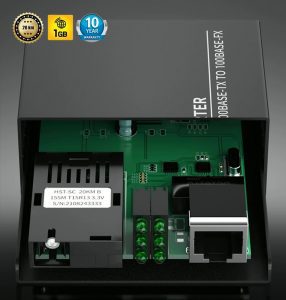
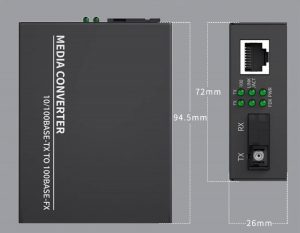
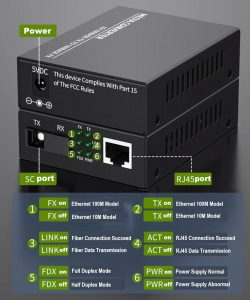
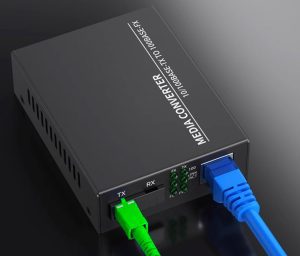
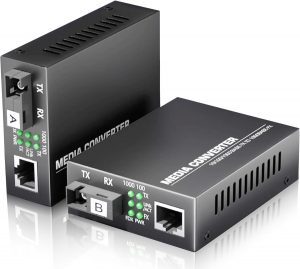
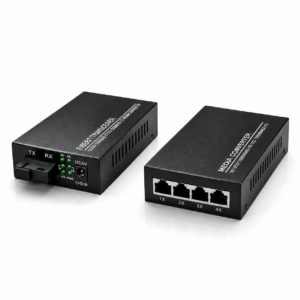
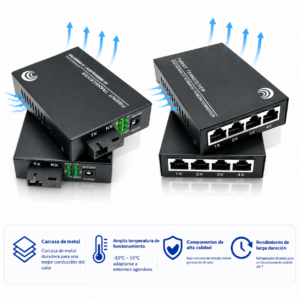
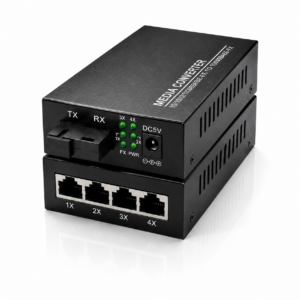
The fiber optic converter is a network device that typically comprises :
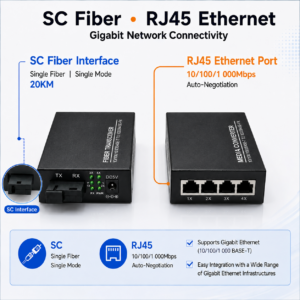
- One or more RJ45 Ethernet ports (copper, 10/100/1000 Mbps or 2.5G/10G)
- One or more fiber ports — either fixed (SC/LC single-mode or multimode), or via an SFP/SFP+ slot to insert an optical module
- An external power supply (5-12V adapter) or internal (PoE, USB)
It provides bidirectional copper ↔ fiber conversion, extending the reach of an Ethernet network while preserving signal integrity.
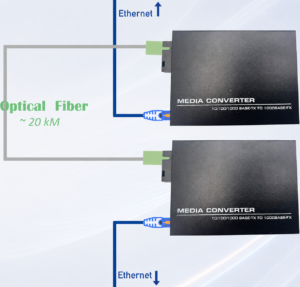
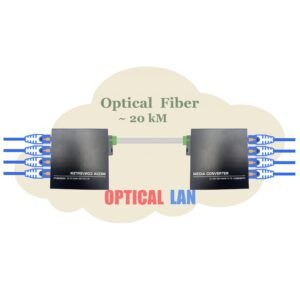
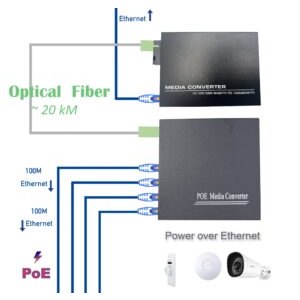
Without a media converter, a Cat 6 Ethernet cable is limited to 100 m. With a pair of media converters and single-mode fiber, the same link can reach 20, 40, or even 80 km without an active repeater.
The 4 main roles of a fiber optic converter
| Role | Concrete benefit |
|---|---|
| Distance extension | Go from 100 m (copper) to 80 km (single-mode) in one step |
| Throughput increase | Go from 100 Mbps Ethernet to 1 Gbps or 10 Gbps via fiber |
| Copper/fiber interoperability | Connect a standard Ethernet switch to an existing fiber backbone |
| Electromagnetic immunity | Cross industrial zones, elevators, solenoid valves without disturbance |
Concrete use cases :
- Home extension (shed, studio) 200 m from the main router — a pair of converters + 1 fiber
- Building in a parking lot 400 m from the technical room
- Hospitality, campsites — WiFi deployment across several scattered buildings
- Industrial — environment with motors, frequency inverters (EMI/RFI)
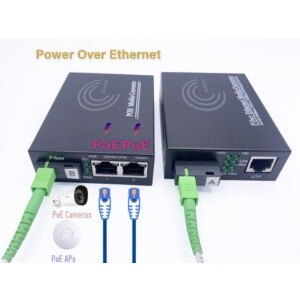
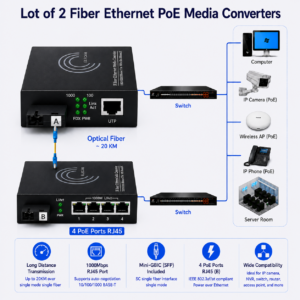
- Extended video surveillance — PoE cameras more than 100 m from the NVR
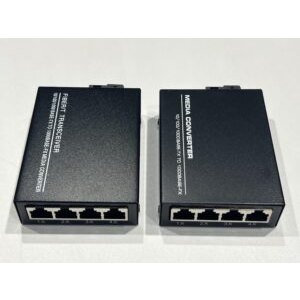
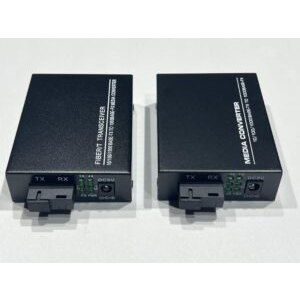
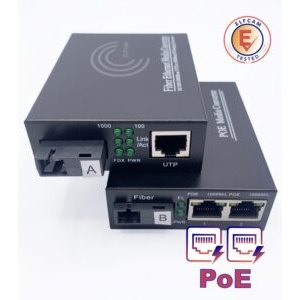
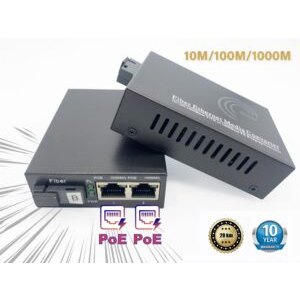
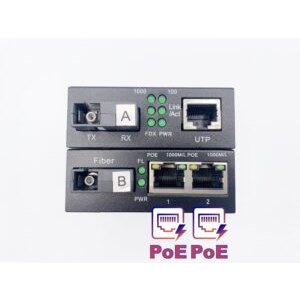
Recommended Elfcam media converters
- Ref 1222 — 1G Ethernet Fiber Converter SFP + 1× SC single-mode, 1310/1550 nm band
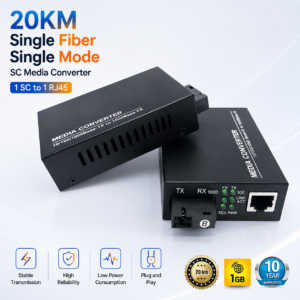
- Ref 2321 — Set of 2 converters with SFP included (ready to plug in), 20 km on single-mode fiber
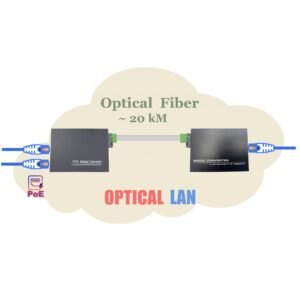
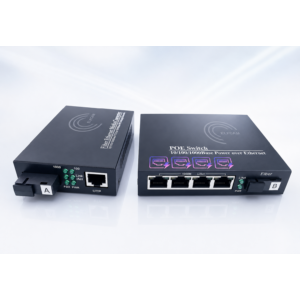
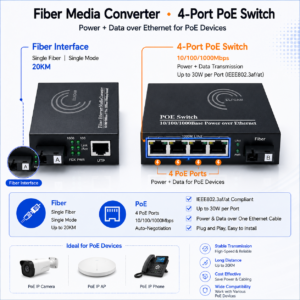
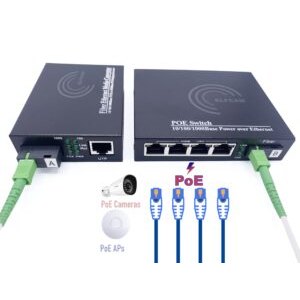
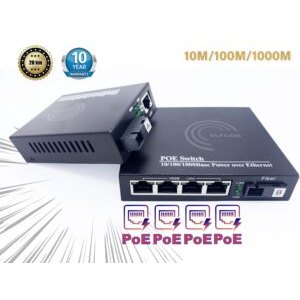
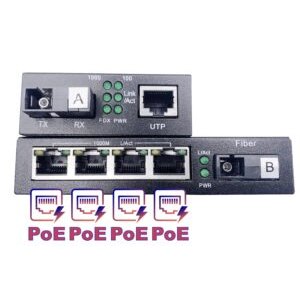
- Ref 4880 — Ethernet fiber converter PoE, 2 RJ45 PoE ports + SFP
- Ref 4896 — Ethernet fiber converter PoE, 4 RJ45 PoE ports + SFP


Key technical characteristics
| Parameter | Common options | How to choose |
|---|---|---|
| Throughput | 10/100 Mbps, 1 Gbps, 2.5 Gbps, 10 Gbps | Depending on current backbone and equipment |
| Fiber distance | 2 km, 20 km, 40 km, 80 km | Depending on physical distance + optical budget margin |
| Fiber type | Single-mode OS2 or multimode OM3/OM4 | Single-mode for > 2 km, multimode for internal datacenter |
| Fiber connector | Fixed SC, fixed LC, SFP/SFP+ slot | Modular SFP = flexibility, fixed SC = simplicity |
| Number of RJ45 ports | 1, 2, 4, 8 | Depending on the number of devices to power |
| PoE | No / 802.3af (15W) / 802.3at (30W) | Yes if IP cameras or WiFi APs at the end of the link |
| Power supply | External 5/12V, PoE, USB | PoE-powered avoids a mains outlet on the remote side |
| Format | Box, DIN rail, 19" rack | Rack for server cabinet, box for standalone |
Pair of converters
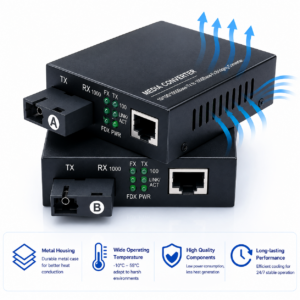
Media converters always work in pairs : one side A (copper → fiber) and one side B (fiber → copper). Sets of 2 (like Ref 2321) are the most convenient, already paired with their SFP modules included.
Types of converters : integrated SFP vs modular SFP
Converter with integrated SFP (fixed)
The fiber comes directly out of a fixed SC or LC connector, soldered to the board. Advantages :
- Cheaper (15-30% savings)
- More compact
- Simple to install (no module to insert)
Disadvantages : not modifiable, if the distance changes you have to buy the entire device again.
Converter with modular SFP/SFP+ slot
A slot accepts a removable SFP module (1G) or SFP+ (10G). Advantages :
- Maximum flexibility: change the module depending on the distance (20 km, 40 km, 80 km)
- Easy upgrade: go from 1G to 10G by changing just the module and the cable
- Compatible with single-mode AND multimode modules as needed
Disadvantages : higher unit price, SFP module to be purchased separately if not included.
How to choose a media converter ?
Six questions to ask yourself to find the right model :
- What distance between the two points to connect ? (< 2 km = multimode, > 2 km = single-mode)
- What throughput needed ? (100 Mbps, 1G, 2.5G, 10G)
- Existing fiber or to be pulled ? If existing, check the type (single-mode OS2 / multimode OM3)
- Power available on the remote side ? If not, prefer a PoE-powered model
- Number of RJ45 ports needed at the destination ? (1, 2, 4, 8)
- Rack or standalone format ?
Browse our range of Elfcam Ethernet fiber converters to find the model that matches your configuration.
Installation and best practices
- Identical pair : both converters must have the same wavelength (1310 nm ↔ 1310 nm) and the same standard (same generation)
- Consistent APC or UPC connector : never mix them, this degrades the signal
- Test before deployment : connect the 2 converters side by side with a short patch cord to validate the pairing
- Gradual commissioning : check the link and activity LEDs before passing the actual traffic
- Lightning protection for outdoor installations (inter-building runs)
- Ventilation : PoE converters heat up, allow 3-5 cm of space
FAQ — Fiber optic converters
1How many converters are needed for a link ?
2Can a media converter be used with any switch ?
3Converter vs switch with SFP port : what is the difference ?
Switch with SFP port : multi-port, can route between several devices, VLAN/QoS management possible.
To connect 2 sites point-to-point : a converter is enough. To distribute fiber to several devices in the same place : a switch with SFP.
4PoE converter : what is it for ?
5Can a 1G converter and a 10G converter be mixed ?
6What is the power consumption of a media converter ?
7Does a fiber converter amplify the signal ?
8Delivery and support ?
In summary
The fiber optic converter is the simple and economical solution to extend an Ethernet network beyond the 100 meters of copper. Choose according to distance, throughput, fiber type, RJ45 ports, PoE, format.
For complex configurations (multi-building, hospitality, industrial), our fiber network solutions include fiber switches, PoE converters and compatible SFP modules.